Showing posts with label Myanmar. Show all posts

Monday, March 05, 2007

On the road to Mandalay


The road to Mandalay by Rudyard Kipling

By the old Moulmein Pagoda, lookin’ eastward to the sea,
There’s a Burma girl a-settin’, and I know she thinks o’ me;
For the wind is in the palm-trees, and the temple-bells they say:
“Come you back, you British soldier; come you back to Mandalay!”
Come you back to Mandalay,
Where the old Flotilla lay:
Can’t you ’ear their paddles chunkin’ from Rangoon to Mandalay?
On the road to Mandalay,
Where the flyin’-fishes play,
An’ the dawn comes up like thunder outer China ’crost the Bay!

’Er petticoat was yaller an’ ’er little cap was green,
An’ ’er name was Supi-yaw-lat—jes’ the same as Theebaw’s Queen,
An’ I seed her first a-smokin’ of a whackin’ white cheroot,
An’ a-wastin’ Christian kisses on an ’eathen idol’s foot:
Bloomin’ idol made o’mud—
Wot they called the Great Gawd Budd—
Plucky lot she cared for idols when I kissed ’er where she stud!
On the road to Mandalay . . .

When the mist was on the rice-fields an’ the sun was droppin’ slow,
She’d git ’er little banjo an’ she’d sing “Kulla-lo-lo!
With ’er arm upon my shoulder an’ ’er cheek agin’ my cheek
We useter watch the steamers an’ the hathis pilin’ teak.
Elephints a-pilin’ teak
In the sludgy, squdgy creek,
Where the silence ’ung that ’eavy you was ’arf afraid to speak!
On the road to Mandalay . . .

But that’s all shove be’ind me—long ago an’ fur away,
An’ there ain’t no ’busses runnin’ from the Bank to Mandalay;
An’ I’m learnin’ ’ere in London what the ten-year soldier tells:
“If you’ve ’eard the East a-callin’, you won’t never ’eed naught else.”
No! you won’t ’eed nothin’ else
But them spicy garlic smells,
An’ the sunshine an’ the palm-trees an’ the tinkly temple-bells;
On the road to Mandalay . . .

I am sick o’ wastin’ leather on these gritty pavin’-stones,
An’ the blasted Henglish drizzle wakes the fever in my bones;
Tho’ I walks with fifty ’ousemaids outer Chelsea to the Strand,
An’ they talks a lot o’ lovin’, but wot do they understand?
Beefy face an’ grubby ’and—
Law! wot do they understand?
I’ve a neater, sweeter maiden in a cleaner, greener land!
On the road to Mandalay . . .


Monks in the teak monastry


Fishing


The Palace in Mandalay at sunset


Buddha on Mandalay Hill pointing to where the royal capital should be built.


A government propoganda billboard


The Teak Bridge outside Mandalay - the longest teak bridge in the world


Monks playing football outside their monastry

Friday, March 02, 2007

As the story Bagan, so shall it end...

I'm still waiting for the rest of the photos of Mandalay and the children then they'll be posted too. In the mean time, here's more from Bagan.


Tuesday, February 27, 2007

It's only just Bagan...

I don't know where to begin on Bagan so I think the photos should do the talking...


Sunday, February 25, 2007

Yangon Days

I don’t know how the Lonely Planet manage to do it. Actually, I think I have an idea: They plough a lot of resources – these being money and patience - into other resources – these being the human capital of travel journalists – who in turn ply their trade by visiting and living in countries for a number of years and therefore, in the kind of shorthand you would use when interviewing a slick tongued politician, manage to encapsulate a country in a book. I’m not implying that this is at all entirely possible, but in a broad-based manner they do a pretty good job with their travel guidebooks.

I wish those resources were available to me, instead I have in my possession, a lot of torn and tacky hotel brochures and business cards, a weathered, Vietnamese $5 copy of Lonely Planet: Myanmar, a lot of photos, a few souvenirs – some with more meaning than others but all with their own distinct story attached - a couple of Ironcross CDs, an “I-am-a-tourist-for-damn-sure” Mandalay Hill t-shirt, a Moustache Brothers T-shirt and DVD and a scattered head full of memories of dust and temples, blood-red stained teeth and smiling children. So I’ll have to make due with what Sarah and I have but I wouldn’t swop it for anything.

I still don’t know where to kick off this story so lets begin at the start. Yangon. There will be no space in this post for Bagan or Mandalay which will have to wait until tomorrow or Tuesday.

Yangon, or Rangoon, as it was known in the Burmese days (the actually colonial time in history, not George Orwell’s 1934 novel) is way past post-colonial, and a long way short of developed infrastructure. Mildewed, gothic architecture holds hands with shantied establishments, all sporting the upside-down, iron umbrella haircut which comes with thousands of satellite dishes beaming in BBC and HBO even though the government urges the people, by means of large billboards and newspaper entries to “oppose those relying on external elements, acting as stooges, holding negative views” and “crush all internal and external destructive elements as the common enemy” (propoganda of which we made signs only to be nearly dispossessed of them, but that's for another day). These colonial façades bake gloriously in the wide-laned main roads and the ramshackled, burned shell of empty buildings throw cool shadows across the beehived alleyways where longyi-wearing men and women squat in the shade, sipping on tea, chew on betel nuts or smoke cheroots.

The motorbikeless roads (another government decree) are badly tarred hobbled affairs – except the one to the international airport which is immaculate –lined by large tropical trees and canalled sidewalks bustling with the trade and furor of the everyday: street markets, food stalls, hawkers, the inevitable tea-shops and betel-nut stalls, all vying for your attention as you traverse the various obstacles that follow in the wake of a people forgotten and oppressed and a city lost despairingly in disrepair: shopkeepers digging the grey, sludgy gunk out of the blocked canals crossing their shopfronts, uneven blocks of cracked concrete haphazardly laid down as if by an ancient, drunk stonemason, decaying litter and stray dogs lazing in the sun.

Yangon has a certain, distinct smell – not unlike Saigon. It is one of those smells you don’t recognise until you leave and return, which is when your olfactory senses light the spark in your neurons. By no means pleasant, it is still reassuring, like home baking or, the comforting sights and sounds of everyday activities that you are used to. It would be audacious and highly ignorant of me to say it’s the smell of hope, but it is intertwined with life of the common Yangon residents. Figuratively, there’s the sharp, sour smell of fear brought about by years of oppression; it mingles with short gasps and jerky, nervous body language and flickering eyes as a troupe of confident police officers straddle through the market. There’s the religious smell of austerity and age-old tradition in the form of musky, incense drifting from shrines and payas (pagodas) blown across the city to settle with the haze of dust and pollution like a smoky, tortoiseshell blanket across Yangon. There’s the smell of business, the musty smell of new and old money exchanging hands for similarly new and used clothes and bolts of cloth accompanied by the constant chatter of merchants and children laughing and crying. Everything in Yangon belies the history of the country and none more so then the people and food. Amidst the noonday bustle Indian faces melt in with lighter, smoother Chinese looks and rounder Burmese faces, and street-stalls selling hin (Burmese curry), noodles, chapattis and Indian curries, whilst a musallee call Muslims to prayer and Buddhist monks in maroon robes trail piously through the streets, creating a smorgasbord of sensory overload.

Yet, despite the melting pot of sights and sounds, the underlying religious principles of Buddhism rule not only the spiritual but also the common, working day lives of the people of Myanmar and Yangon. Perhaps it is partly due to the ever-present payas, with their intricately designed statues, steps and shrines that stand as sentinels and watch solemnly as the golden hue of their roof reflects brilliantly in the midday sun for all to see and is lit up magnificently at night. None more so then the massive and noble, jewel and gold encrusted Shwe Dagon Paya that stands as out of place as a magnificently polished, antique centrepiece would stand on an unvarnished, weathered table that has only three legs. Perhaps the ever presence of the omnipotent is what causes the Burmese to practise their religion so devoutly and live life with such simple austerity and sincerity, perhaps it is tradition suffused in this sea of mental well-being and future freedom from suffering, that is one of the primary practises of Therevada Buddhism, that causes the Burmese to have what seems to be such ease and acceptance with their situation.

Ironically, it is perhaps partly these principles of Therevada which allow the government to maintain such power and domination over the country – besides the everpresent fear of being thrown in prison for a unforeseeable amount of time or, worse, lugged off to a forced labour camp in the northern rural provinces of a country for no reason other than having the entrepreneurial spirit to show a tourist around town, that is. This actually happened to the brother of Kin Se Be, a young girl we met. At age 14 he was taken to prison and three years later he is still in prison while she now took up the reigns where he left off to make some extra money after to school to buy food and necessities to take to her brother.

I’ll harp on about this point often but this country truly is one of contradictions. It is baffling to think how such beauty and serenity which can be found everywhere in a city and people that is so stifled by the white-knuckled grip of a government that knows no other way than to force their autocratic, tyrannical priniciples upon those beneath them to the point of strangling. The contradiction of a broad-faced face split in half with a smile, showing a mouthful of betel-nut-stained teeth and a cheerful “Mingalaba!” (Hello!), only to recognise the trepidation and well-hidden panic in the eyes behind. This is truly a country where serenity and beauty can sit hand in hand at the same table as fear and hopelessness.


Friday, February 09, 2007

I've packed my bags...

Everything's sorted; the couriered visas arrived today, dong has been changed to dollars, valiums have been purchased and still don't have a clue where or what we're going to do in Myanmar. We're flying in about an hour so have a good Tet holiday everyone and I'll post again in about 2 weeks! Chuc Mung Nam Moi! (Happy New Year)!
PS: If you don't hear from me again, phone your nearest Amnesty International office and set up a petition to put pressure on the Burmese government for the release of the two young political prisoners from SA and Oz who, suprisingly, have been detained due to inciting riot and propoganda against the Burmese biter monkeys in north Mandalay. Much obliged.

Tuesday, January 16, 2007

Minor setback

Battle Cruiser. Boozer. Gaydar. Gay radar (which I only heard for the first time last night. Backne. Back Acne. Some words go well together and make wonderful little roll-off-the-tongue sayings. Two things, which just don’t go that well together, are “washing machine” and “passport”. Now, I’m not referring to my post before last about the metaphorical “washing machine that is my life”, but the real deal. The one that whirs and spits and splutters powder and fabric softener mixed with tangible, hot water in anti-clockwise revolutions. That one. And let me tell you, there’s no word like washport, or passwash or whatever you wanna come up with. They’re like chalk and cheese, which I’d like to write to the good folks at the Oxford Complete English Dictionary about suggesting they change it to detergent and important document.
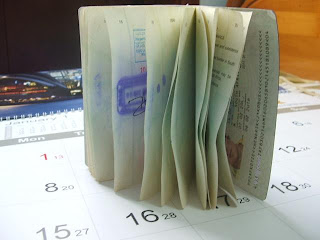
It happened on Sunday, when Mr Diep’s, our good friend and landlord, younger sister came over to collect my clothes for washing (and I don’t want any grief from anyone for not washing my own clothes, I used to and still would if Diep didn’t insist his sister do it – and I pay her). I’d left the little book in my pants pocket by accident, was away playing football and when I came back – neatly balanced on top of a book, sat my sopping, sodden passport, ruffled like a mangy chicken, looking like something the cat dragged in, dropped in the bog and fished out again. I couldn’t inspect the damage just then so I just left it out to dry until this morning and muffled the screams in my pillow, biting my knuckles until the blood rage drained from my eyes and murder didn’t seem like the best idea since condoms. Actually, I’m pretty easy. After all, it was an honest mistake and half my fault anyways so I’m not that pissed off, just frustrated now. Bygones.


This Myanmar trip might just have incurred its first minor setback. The other problem is that the South African Consulate is up in Hanoi so it’s not just a case of heading over and asking them to take a look at it and make a diagnosis: “I’m sorry son, it’s not going to make it.” So, I think I’m going to take some pics of the worst pages and mail to it them. Hope it works.


Damn bureaucratic red tape. Whatever happened to exploring the world with a handful of coins, perhaps a pirate ship at your disposable, perhaps a peg-leg or parrot and a crew of able seaman? The world was your oyster. Pirates get more booty anyhow.

Sunday, January 14, 2007

Mission Myanmar

(To the tune of the BN Biscuits advertisements):

Myan-Myan, Myan-Myan,
Da daa, da da da daa,
Myan-Myan, Myan-Myan,
Da daa, da da da daa,
Myan-Mar!


From: bulgar.no-ip.info


Travelling companion and good friend, crazy Aussie girl Sarah, and I headed down to Pham Ngu Lao to book our tickets to Myanmar (Burma). It looks like this thing is actually going to happen, static sheets for my tumble-dryer or not, much to my disbelief; disbelief as I had to buy a Lonely Planet Guide (after much haggling with the bookseller) for 80 000 vnd ($5) just to find where it was on a map and didn't really think things through when I agreed to accompany crazy teacher girl. Okay, I didn't just buy the LP for the map; it's got truckloads of other useful info and a handful of otherwise miscellanous facts.

Allow me to digress. Under the topic Dangers and Annoyances: Bugs, Rats, Snakes and Monkeys they write: "Monkeys, too, can get a little friendly in places. A guide outside Monya pointed out natural medicines for 'not shitting', 'shitting' and 'snakebites', but said that there's nothing for monkey bites. 'Monkey bite is normal', he said."

Great, one less thing than to worry about, as in Myanmar it seems "normal" to get rabies from a monkey bite, become delusional, sinking deeper into the mental deficient quagmire called insanity, foam at the mouth, get lockjaw and die.

I'm really excited about this trip though. I'm like a grade 6 boy at his first "dance" party; you know the kind, with the table with the snacks and plastic cups on one side, a group of brace-faced, hormonal boys standing against one wall mustering up the courage to cross the divide, across the frontier to the other extreme of the room, where girls try their hardest to ignore the boys secretely hoping they'll be the ones that are asked to dance first.

We land in Yangon (formerly Rangoon) from Bangkok on the 10th of February and are staying for about 10 days. According to wikipedia, Yangon literally means "run out of enemies" or "the end of strife". I sincerely hope that is the feeling which will float down like mana from heaven to rest like a feather on my shoulders. I also really want to visit the myriad of temple ruins and complexes such as the ancient capital Mrauk U which now lies in ruins as well the last royal capital Mandalay.


Yangon from: www.asiatours.net

Obviously, as if there was any doubt, Sarah and I sealed the deal with a bottle of Go2 Cafe's finest Vietnamese Rhum and a impromptu version of "Myan-Myan" the BN song. BN, interestingly enough is also the ISO 639 alpha-2 language code for the Bengali language, an Indo-Aryan language of South East Asia. You're never to old to learn.

I'll keep updating as Mission Myanmar progresses.